The site had been cleared. The rip rap rock and mulch sat in two large piles, staged as close to the site as possible. The team had gathered (so many thanks to Lori, Dan, Susan, Paddy, Sharon, Becky, and Kathy for giving up a Sunday afternoon to share in this project that means so much to me!) to await instructions from our designer, David-Anthony Curtis. We were ready to create a labyrinth!
David began by leading us in prayers for healing and peace and explaining a bit about labyrinths. He reminded us that we were indeed creating a sacred space in the midst of God's creation. In doing so, we would be unleashing a divine energy in that grove of trees and reconnecting to the earth in a new and powerful way.
With diagram and tape measure in hand and a wealth of experience in his head and heart, David laid out large "guide stones" that would represent points bordering the center of the labyrinth as well as key places where paths would begin and end, twist and turn. Our job, as he explained it, would be to fill in the spaces in between these guide stones by intentionally placing rocks that "fit" next to one another, always touching, so the paths would be continuous and complete.
While some of us helped David measure to be sure that the pathways would be about 2 1/2 feet wide, others of us filled a wheel barrow and a trusty sturdy wagon many times over with stones measuring anywhere from 6 inches to well over a foot in diameter and moved them to the site to complete the borders of the pathways. We ended up needing a bit more space than I had originally cleared, so we cut down a couple more small trees as well and raked back pineneedles and brush a couple more feet in one area.
It took quite a while to envision the labyrinth taking shape. Until quite close to the end of the construction, it looked like disconnected stones and circles. Then, all of sudden, the labyrinth fell together before our eyes. We could see the short and direct way into the center as well as the more traditional pathways winding back on eachother that also led to the center.
What earlier in the afternoon looked more like a maze, which has many pathways and deadends and is intended to confuse and confound, now obviously there was one short way in and out of the center and one long way in and out. These continuous circuits are what differentiates a labyrinth from a maze - a clear path in and a clear path out. Set before us in stone was a representation of the journey that each one of us takes in our own lives. The path may at times look and feel confusing and chaotic, but if we just keep walking, we will get to the center - the place where we will find God.
With the stonework done, the task before us was to fill in the pathways between the stones with rich, dark mulch. And so we turned to the enormous mulch pile and began shoveling it into the wheel barrow. We dukmped load after load on the pathways to be raked out smoothly. We got about a third of it mulched by the end of the afternoon.
We took a bit of time to admire our handiwork. The white of the stones and the black of the mulch made for a powerful combination. Susan led us in a blessing of the labyrinth at the end of our work day. We gathered in the center of the labyrinth, talked about our experience of building it,and said a prayer together. Then we all walked out of the labyrinth - one at a time, at our own pace. I think we all truly felt that we were treading on holy ground.
I will be finishing up the mulching over the next week - and then will begin the process of landscaping ithe labyrinth site and purchasing a stone bench for the center. I have lots of ideas for planting bulbs, transplanting ferns, working with the sun and shadows to create garden spots around the area as well as clearing even more alot of the branches I removed earlier. I look forward to working on and enjoying this sacred space.
Wednesday, August 17, 2011


Friday, August 12, 2011
The Labyrinth Project
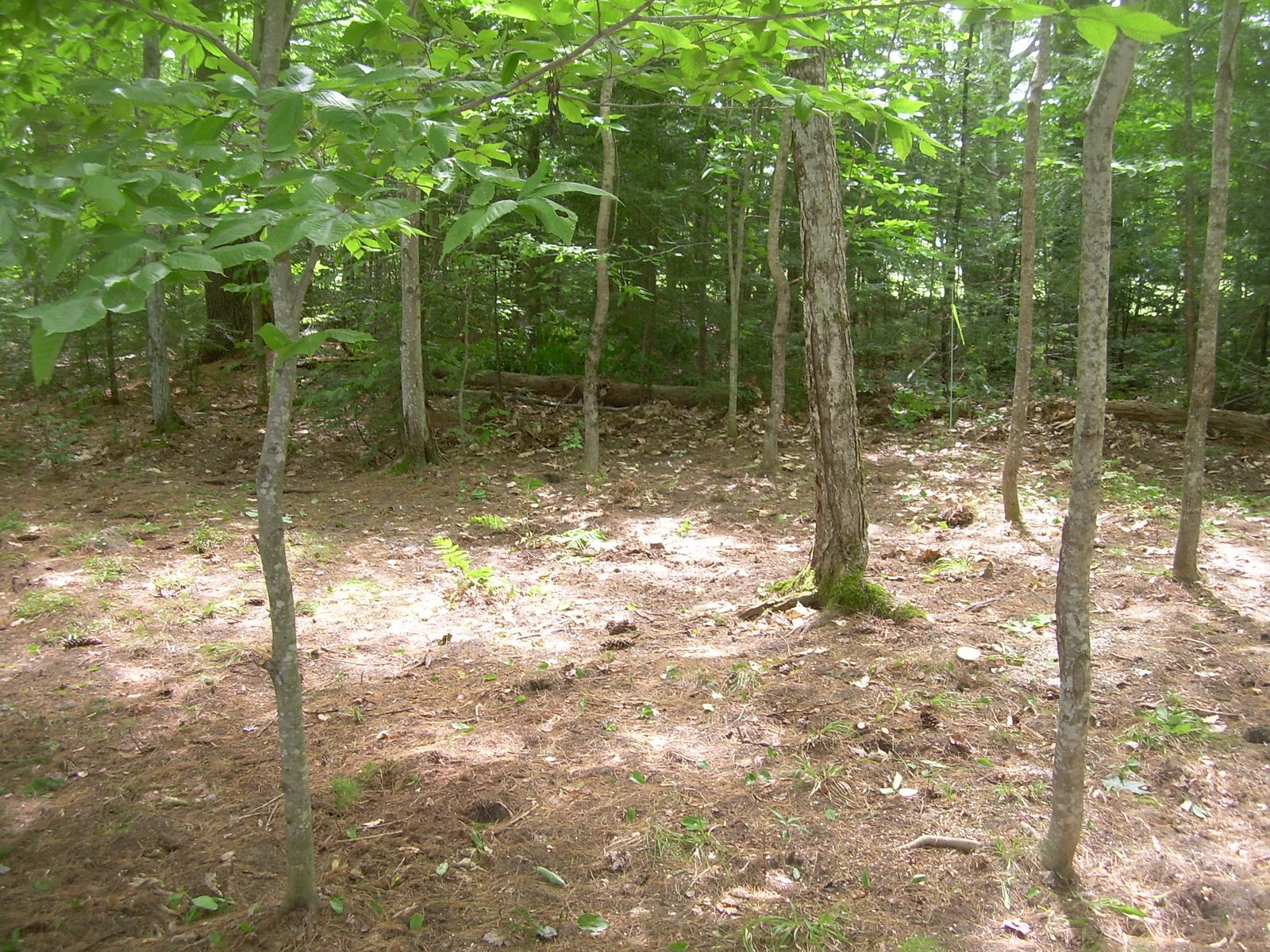
Here's the labyrinth site before any clearing had been done.
 Many pine needles and roots later, the site is mostly cleared.
 We still need to take out the small trees.
 Here's Joe in the tractor - moving stone and mulch!
 Alot of loads and many hours later, he's still happy!
 Here's the site after the small trees have been removed - and a lot of wheel barrow loads of sand have been brought in to level it.
 All that stone was moved from our driveway to the edge of the site - thanks to Joe and the tractor!
 Same with the mulch!
 Here are all the rocks dug up on the site that will be used to form the border of the center of the labyrinth.


 Many pine needles and roots later, the site is mostly cleared.
  We still need to take out the small trees.
  Here's Joe in the tractor - moving stone and mulch!
  Alot of loads and many hours later, he's still happy!
  Here's the site after the small trees have been removed - and a lot of wheel barrow loads of sand have been brought in to level it.
  All that stone was moved from our driveway to the edge of the site - thanks to Joe and the tractor!
  Same with the mulch!
  Here are all the rocks dug up on the site that will be used to form the border of the center of the labyrinth.
My Labyrinth Journey
My labyrinth journey began several years ago when I attended a labyrinth workshop at the Annual Meeting of the Maine Conference/United Church of Christ. I had an opportunity that day to walk a large indoor canvas labyrinth - and have been intrigued ever since by the labyrinth as a tool for prayer and meditation. Since then I have attended a couple of other labyrinth workshops and walked indoor labyrinths of various sizes and designs. I have also walked outdoor labyrinths - at the Unity Church in Portland and at Carleton College. I am looking forward to walking the labyrinth on the Isle of Iona in the fall.
As I designed this sabbatical time, I came to realise that building an outdoor labyrinth at our farm was an important aspect of my renewal experience. It would give me a chance not only to further explore this ancient meditation tool, but the project would also encourage me to reconnect to nature and to the earth in a deeply spiritual way.
David-Anthony Curtis from Whispering Grove in Phippsburg, Maine is working with me on this project. We are going to use a Baltic Design. There will be a short and direct way to the center in addition to the more traditional circuitous route. One will choose upon entering the labyrinth which way he or she will walk to the center.
I wanted the labyrinth to be in a fairly shady spot, so I chose a site on the edge of the woods bordering our field. When it rained so much this past spring, I marked off an area that somehow stayed fairly dry. Earlier this spring and summer, I raked and cleared the circular area measuring approximately 40 feet in diameter of pine needles and tufts of grass and small plants.
Since that time, I have also cut out roots of various sizes and dug up rocks that were breaking the surface. I plan to use rocks from our property for the border of the center of the labyrinth and now have quite a good collection! Paddy and Joe have also cut down about a dozen small trees in order to open up the site even more. Now the area is bathed in dappled sunlight for a good part of the day.
I ordered rocks (rip rap sized larger than 6 inches) for the pathway borders and mulch for the pathways themselves. This was all delivered recently (10 yards of each based on conversations with and calculations of several landscape and hardscape professionals), and so last weekend we rented a tractor to move it all as close to the site as possible. What a time consuming job that was!
Joe also removed most of the stumps on the site and a bunch of roots close to the surface. And so this week I have been bringing in wheel barrow loads of sand from another part of our property to fill in the holes and level the site as much as possible. I have been doing four wheel barrow loads a day and then raking it all out.
This weekend - weather permitting (!) - David is coming to design the labyrinth. A group of 6-7 friends who all expressed an interest to me in being part of the project will be on hand to do the stonework and fill in the pathways with mulch. When we finish this weekend - or don't quite finish as the case may be - we will have a blessing of the labyrinth. After all, the journey is what is important. I am so grateful to everyone who has helped out in so many ways so far!
Overtime, I will be landscaping around the labyrinth. I hope to have a small stone bench at the center and a Celtic cross at the entrance.
As I designed this sabbatical time, I came to realise that building an outdoor labyrinth at our farm was an important aspect of my renewal experience. It would give me a chance not only to further explore this ancient meditation tool, but the project would also encourage me to reconnect to nature and to the earth in a deeply spiritual way.
David-Anthony Curtis from Whispering Grove in Phippsburg, Maine is working with me on this project. We are going to use a Baltic Design. There will be a short and direct way to the center in addition to the more traditional circuitous route. One will choose upon entering the labyrinth which way he or she will walk to the center.
I wanted the labyrinth to be in a fairly shady spot, so I chose a site on the edge of the woods bordering our field. When it rained so much this past spring, I marked off an area that somehow stayed fairly dry. Earlier this spring and summer, I raked and cleared the circular area measuring approximately 40 feet in diameter of pine needles and tufts of grass and small plants.
Since that time, I have also cut out roots of various sizes and dug up rocks that were breaking the surface. I plan to use rocks from our property for the border of the center of the labyrinth and now have quite a good collection! Paddy and Joe have also cut down about a dozen small trees in order to open up the site even more. Now the area is bathed in dappled sunlight for a good part of the day.
I ordered rocks (rip rap sized larger than 6 inches) for the pathway borders and mulch for the pathways themselves. This was all delivered recently (10 yards of each based on conversations with and calculations of several landscape and hardscape professionals), and so last weekend we rented a tractor to move it all as close to the site as possible. What a time consuming job that was!
Joe also removed most of the stumps on the site and a bunch of roots close to the surface. And so this week I have been bringing in wheel barrow loads of sand from another part of our property to fill in the holes and level the site as much as possible. I have been doing four wheel barrow loads a day and then raking it all out.
This weekend - weather permitting (!) - David is coming to design the labyrinth. A group of 6-7 friends who all expressed an interest to me in being part of the project will be on hand to do the stonework and fill in the pathways with mulch. When we finish this weekend - or don't quite finish as the case may be - we will have a blessing of the labyrinth. After all, the journey is what is important. I am so grateful to everyone who has helped out in so many ways so far!
Overtime, I will be landscaping around the labyrinth. I hope to have a small stone bench at the center and a Celtic cross at the entrance.
Thursday, August 11, 2011
Photos from Choquechirao
 Here's Paddy about to enter Choquequirao, walking by an ancient Incan wall.
 These are some of the partially uncovered terraces. You can see some of the rest of the site as well.
 Choququirao from above
 Walls and terraces
 Walls and terraces - you can see that the site has not been reconstructed or restored - see the cacti just growing there!
 This glacier may have had something to do with choosing this sacred site of Choquechirao
 We have all arrived - 31.5 km after we left Cachora two days ago!
Check out the Links!
I have added a couple of links on this blog, so you can get a better idea of where I have been. A picture's worth a thousand words, as they say....
There is one about Cusco and another about Machu Picchu. I also included one about hiking to Choquechirao to give you an idea of the terrain we encountered.
I'll also be adding something about labyrinths soon.
There is one about Cusco and another about Machu Picchu. I also included one about hiking to Choquechirao to give you an idea of the terrain we encountered.
I'll also be adding something about labyrinths soon.
Wednesday, August 10, 2011
Experiencing the Sacred in Peru
Sylvia Maddox wrote, "There is a Celtic saying that heaven and earth are only three feet apart, but in the thin places that distance is even smaller. A thin place is where the veil that separates heaven and earth is lifted and one is able to receive a glimpse of the glory of God. A contemporary poet Sharlande Sledge gives this description.
It is no wonder that thin places are most often associated with wild landscapes. A thin place requires us to step from one world to another and that often means traveling to a place where we have less control and where the unpredictable becomes the means of discovery."
For me, Peru is most definitely a "thin place." Part of my reason for exploring Peru with my family during this sabbatical/renewal time was to explore sacredness and sacred spaces in new and different ways. Here are just a few of my experiences in doing so.
1. Choquequirao - I chose the Choquequirao trek for no reason other than I wanted an alternative to the much traveled Inca Trail, and Choquequirao seemed to fit into our schedule. It was only after hearing Puma talk about its origins and see our guides approaching the trek much like a pilgrimage did I realize that I had chosen one of the most sacred of Inca sites to travel to and explore. It is accessible only by the trail we hiked and so there were only a handful of other people there when we arrived. It is deep in the mountains. It has only been partially excavated - 60% of the site is still under the cover of trees and vines. The stonework belies the commonly held view that Choquechirao was built only as the last refuge and fortress of the Incas following the Spanish Conquest. Perhaps it was used for that purpose, but Choquechirao was built far earlier and was like a monastery - home to the high priests, a site for priestly training, and perhaps a pilgrimage destination. Our discoveries of niches for mummies and offerings, the condors flying overhead, and the sense that we had arrived at some place very special will always mark Choquechirao as a sacred space for me, one that I was privileged to visit and explore.
2. The Mountains - The mountains are so vast, it makes one feel so small, such a tiny part of the universe, of God's creation. Traveling by mountain faces dotted with caves that once - or maybe still - hold Incan mummies makes one feel deeply a sense of the ancient and a connection with times both past and future. The mountains were sacred to the Incas, inhabited by the apus, the spirits of the mountains that protected the local people. They became sacred spaces for me as well.
3. The Caves - There were several that stand out in my mind. Outside of Cusco, there was the heart of the puma, a reddish rock that jutted down from the mouth of a cave. You can reach out and grab hold of the heart, pull it close, even lift your feet just a few inches off the ground - and as you hold it, you give all the heaviness in your heart to the puma, who graciously accepts it. There is the cave of the puma on the trail to Huayna Picchu. You might leave a few coca leaves near the rock that, when you look closely, is indeed shaped like a puma's head. After a time of silence and perhaps a prayer, you can exit the cave, but only on your hands and knees. When you emerge, it is said that you emerge with the strength of the puma within you. There is also the condor cave at Machu Picchu. The condor is symbolic of the one of the three senses of self in Incan culture. The serpent represents the conscious self, the puma the physical self, and the condor the divine spark which is in each one of us. Exiting the condor cave, you are minded of the divine spark and the light from which all of us comes and to which all of us are connected.
4. Spanish Language Mass at the Cathedral in Cusco - I attended one of the four daily masses at the cathedral. It was in Spanish, and I complement myself for figuring out that the Gospel reading was about the hemorrhaging woman from Luke having enough of a grasp of Spanish to be able to share the peace of Christ with those around me. There is something unique about attending worship in a huge basilica (even an unheated one). The stone columns, flickering candles, statuary, and massive paintings add something unusual to the experience. This cathedral is an interesting one to poke around in. Built by the Spanish, some of the artwork was done by the Cusquena School of artists. They were imaginative and creative in the ways that they incorporated Andean culture into their work. Perhaps the best example is a huge painting of the Last Supper. Jesus is holding a loaf of bread in his hands, and a chalice of wine is nearby. At first glance, there is nothing unusual with the scene. A closer look, however, reveals a cuy (guinea pig, Peruvian gastronomic delicacy), roasted, its little feet sticking up in the air, on a platter in the center of the table.
5. My Family - Perhaps the very best part of this journey was being able to share it with first my immediate family - and then extended to include my Peruvian family. With the kids grown, we really are all of us together only for a day or so at Christmas. To be able to spend these three weeks with Joe, Heather, Paddy, and Tim was so special, and that part of the experience is something I will always hold close to my heart. To be able to share it with Puma and his family was special as well. I believe that God did not create us to live in isolation from one another, but rather in community, bound together, bound to our past and to our future, in a sort of sacred web.
“Thin places,” the Celts call this space,
Both seen and unseen,
Where the door between the world
And the next is cracked open for a moment
And the light is not all on the other side.
God shaped space. Holy.
Both seen and unseen,
Where the door between the world
And the next is cracked open for a moment
And the light is not all on the other side.
God shaped space. Holy.
It is no wonder that thin places are most often associated with wild landscapes. A thin place requires us to step from one world to another and that often means traveling to a place where we have less control and where the unpredictable becomes the means of discovery."
For me, Peru is most definitely a "thin place." Part of my reason for exploring Peru with my family during this sabbatical/renewal time was to explore sacredness and sacred spaces in new and different ways. Here are just a few of my experiences in doing so.
1. Choquequirao - I chose the Choquequirao trek for no reason other than I wanted an alternative to the much traveled Inca Trail, and Choquequirao seemed to fit into our schedule. It was only after hearing Puma talk about its origins and see our guides approaching the trek much like a pilgrimage did I realize that I had chosen one of the most sacred of Inca sites to travel to and explore. It is accessible only by the trail we hiked and so there were only a handful of other people there when we arrived. It is deep in the mountains. It has only been partially excavated - 60% of the site is still under the cover of trees and vines. The stonework belies the commonly held view that Choquechirao was built only as the last refuge and fortress of the Incas following the Spanish Conquest. Perhaps it was used for that purpose, but Choquechirao was built far earlier and was like a monastery - home to the high priests, a site for priestly training, and perhaps a pilgrimage destination. Our discoveries of niches for mummies and offerings, the condors flying overhead, and the sense that we had arrived at some place very special will always mark Choquechirao as a sacred space for me, one that I was privileged to visit and explore.
2. The Mountains - The mountains are so vast, it makes one feel so small, such a tiny part of the universe, of God's creation. Traveling by mountain faces dotted with caves that once - or maybe still - hold Incan mummies makes one feel deeply a sense of the ancient and a connection with times both past and future. The mountains were sacred to the Incas, inhabited by the apus, the spirits of the mountains that protected the local people. They became sacred spaces for me as well.
3. The Caves - There were several that stand out in my mind. Outside of Cusco, there was the heart of the puma, a reddish rock that jutted down from the mouth of a cave. You can reach out and grab hold of the heart, pull it close, even lift your feet just a few inches off the ground - and as you hold it, you give all the heaviness in your heart to the puma, who graciously accepts it. There is the cave of the puma on the trail to Huayna Picchu. You might leave a few coca leaves near the rock that, when you look closely, is indeed shaped like a puma's head. After a time of silence and perhaps a prayer, you can exit the cave, but only on your hands and knees. When you emerge, it is said that you emerge with the strength of the puma within you. There is also the condor cave at Machu Picchu. The condor is symbolic of the one of the three senses of self in Incan culture. The serpent represents the conscious self, the puma the physical self, and the condor the divine spark which is in each one of us. Exiting the condor cave, you are minded of the divine spark and the light from which all of us comes and to which all of us are connected.
4. Spanish Language Mass at the Cathedral in Cusco - I attended one of the four daily masses at the cathedral. It was in Spanish, and I complement myself for figuring out that the Gospel reading was about the hemorrhaging woman from Luke having enough of a grasp of Spanish to be able to share the peace of Christ with those around me. There is something unique about attending worship in a huge basilica (even an unheated one). The stone columns, flickering candles, statuary, and massive paintings add something unusual to the experience. This cathedral is an interesting one to poke around in. Built by the Spanish, some of the artwork was done by the Cusquena School of artists. They were imaginative and creative in the ways that they incorporated Andean culture into their work. Perhaps the best example is a huge painting of the Last Supper. Jesus is holding a loaf of bread in his hands, and a chalice of wine is nearby. At first glance, there is nothing unusual with the scene. A closer look, however, reveals a cuy (guinea pig, Peruvian gastronomic delicacy), roasted, its little feet sticking up in the air, on a platter in the center of the table.
5. My Family - Perhaps the very best part of this journey was being able to share it with first my immediate family - and then extended to include my Peruvian family. With the kids grown, we really are all of us together only for a day or so at Christmas. To be able to spend these three weeks with Joe, Heather, Paddy, and Tim was so special, and that part of the experience is something I will always hold close to my heart. To be able to share it with Puma and his family was special as well. I believe that God did not create us to live in isolation from one another, but rather in community, bound together, bound to our past and to our future, in a sort of sacred web.
Tuesday, August 9, 2011
Sacred Sounds
My personality type is INFJ (introverted intuitive feeling judger). Among other things, that means that I tend to see the big picture and overlook the details. I don't see those dust bunnies until they are practically overtaking the livingroom. Unfinished projects around the house over time simply get incorporated into the general scheme of things. In short, being an INFJ also means that my worldview and reality is not naturally shaped and defined by using my five senses.
When the church and I applied for the Lilly Endowment National Clergy Renewal Grant (which has allowed me the opportunity to do these extraordinary things during my sabbatical), I proposed that I would try to experience and reflect upon my sabbatical time using my five senses. I wanted to use my sense of hearing during our Peru adventure to sharpen that particular experience.
So - what sounds enhanced my time in Peru and will always be part of my memories of those three weeks? Here are just a few:
1. The Andean Flutes - Puma and Ruben were both experienced in playing the flute. I shall remember the silhouette of Puma seated on a rock overlooking the Inka Bridge at Machu Picchu. Heather was lying on the ledge gazing at the sheer rock and stomach-turning drop of thousands of feet. Puma was playing an Andean melody on his flute. I remember Ruben creating similar music after he left three coca leaves as a sign of blessing for all of us at the base of a waterfall early on our trek to Choquequirao. On that same journey, I will recall hearing the sound of flutes beckoning us on as we trudged downhill into the heat of the canyon toward the Apurimac River. Sometimes the music was light and cheerful. Sometimes it encouraged deep reflection. Always it was mystical and haunting.
2. The Spanish Language (and some Quechua, which is the language of indigenous Peruvians) - I was glad I knew a tiny bit of Spanish and wish I had known more. It was fun to bargain in Spanish for items in the markets - even though most of the vendors spoke at least some English. Heather, Paddy, and Tim were all excellent translators. It might be a joke, a general strain of conversation, the text of the detailed explanations at the Museo de Plantas Sagradas, Medicinales (the Museum of Sacred, Magical, and Medicinal Plants) (Thanks Heather!), or Ruben's passionate explanation of the plants along the way to the summit of Huayna Picchu and in the botanical garden at Machu Picchu proper.
3. The Absence of Sound - There is an ancient silence you experience high in the mountains. It imbues you with a sense that there is way more to life that we as humans can ever know. It is quite humbling. I will also remember leaving the dining tent in the dark after dinner on our trek to Choquequirao and gazing at the zillion stars overhead in the crystal clear inky black night sky. The Milky Way was like a white pathway across the heavens. The Southern Cross was visible as was the extra blackness near it that the ancient Incas referred to as the Black Llama.
4. The Farm Animals - Our final campsite on the trek to Choquequirao was on the land of a local farmer. The family owned a cow, a pig, a bunch of chickens, and five roosters. At night, I think the pig was camped out on a hillside behind our tents. I heard it oinking for a while shortly after we went to bed. During the first night, the roosters began greeting the day well before dawn - closer to 3:00 A.M. The second night there were only two roosters (See my post on our trek to Choquequirao for details). One of them seemed to bed down very close by and half heartedly cock-a-doodle-do'ed most of the night. It is one thing to greet the day, but it is another to be simply annoying!
5. The Laughter, Tears, Singing, and Sharing at Our Closing Circles - Each evening after dinner on our 5 day trek, Paddy and Heather led us in a Closing Circle where we each shared a highlight (and one evening a low point as well) of the day. Our guides shared in Spanish and we in English, and Puma translated. At least one of us cried just about every evening as we talked about something close to our hearts. We also laughed, as we recalled such memories as cooling off - some of us fully clothed - in the Apurimac River. Heather sang one evening; I never knew she had such a beautiful voice. Through this time of listening and sharing, I realized the importance and sense of sacredness that our four guides (and now friends) brought to this particular trek. These moments were so special as my sense of family grew from just the five of us to nine.
When the church and I applied for the Lilly Endowment National Clergy Renewal Grant (which has allowed me the opportunity to do these extraordinary things during my sabbatical), I proposed that I would try to experience and reflect upon my sabbatical time using my five senses. I wanted to use my sense of hearing during our Peru adventure to sharpen that particular experience.
So - what sounds enhanced my time in Peru and will always be part of my memories of those three weeks? Here are just a few:
1. The Andean Flutes - Puma and Ruben were both experienced in playing the flute. I shall remember the silhouette of Puma seated on a rock overlooking the Inka Bridge at Machu Picchu. Heather was lying on the ledge gazing at the sheer rock and stomach-turning drop of thousands of feet. Puma was playing an Andean melody on his flute. I remember Ruben creating similar music after he left three coca leaves as a sign of blessing for all of us at the base of a waterfall early on our trek to Choquequirao. On that same journey, I will recall hearing the sound of flutes beckoning us on as we trudged downhill into the heat of the canyon toward the Apurimac River. Sometimes the music was light and cheerful. Sometimes it encouraged deep reflection. Always it was mystical and haunting.
2. The Spanish Language (and some Quechua, which is the language of indigenous Peruvians) - I was glad I knew a tiny bit of Spanish and wish I had known more. It was fun to bargain in Spanish for items in the markets - even though most of the vendors spoke at least some English. Heather, Paddy, and Tim were all excellent translators. It might be a joke, a general strain of conversation, the text of the detailed explanations at the Museo de Plantas Sagradas, Medicinales (the Museum of Sacred, Magical, and Medicinal Plants) (Thanks Heather!), or Ruben's passionate explanation of the plants along the way to the summit of Huayna Picchu and in the botanical garden at Machu Picchu proper.
3. The Absence of Sound - There is an ancient silence you experience high in the mountains. It imbues you with a sense that there is way more to life that we as humans can ever know. It is quite humbling. I will also remember leaving the dining tent in the dark after dinner on our trek to Choquequirao and gazing at the zillion stars overhead in the crystal clear inky black night sky. The Milky Way was like a white pathway across the heavens. The Southern Cross was visible as was the extra blackness near it that the ancient Incas referred to as the Black Llama.
4. The Farm Animals - Our final campsite on the trek to Choquequirao was on the land of a local farmer. The family owned a cow, a pig, a bunch of chickens, and five roosters. At night, I think the pig was camped out on a hillside behind our tents. I heard it oinking for a while shortly after we went to bed. During the first night, the roosters began greeting the day well before dawn - closer to 3:00 A.M. The second night there were only two roosters (See my post on our trek to Choquequirao for details). One of them seemed to bed down very close by and half heartedly cock-a-doodle-do'ed most of the night. It is one thing to greet the day, but it is another to be simply annoying!
5. The Laughter, Tears, Singing, and Sharing at Our Closing Circles - Each evening after dinner on our 5 day trek, Paddy and Heather led us in a Closing Circle where we each shared a highlight (and one evening a low point as well) of the day. Our guides shared in Spanish and we in English, and Puma translated. At least one of us cried just about every evening as we talked about something close to our hearts. We also laughed, as we recalled such memories as cooling off - some of us fully clothed - in the Apurimac River. Heather sang one evening; I never knew she had such a beautiful voice. Through this time of listening and sharing, I realized the importance and sense of sacredness that our four guides (and now friends) brought to this particular trek. These moments were so special as my sense of family grew from just the five of us to nine.
Subscribe to:
Posts (Atom)